
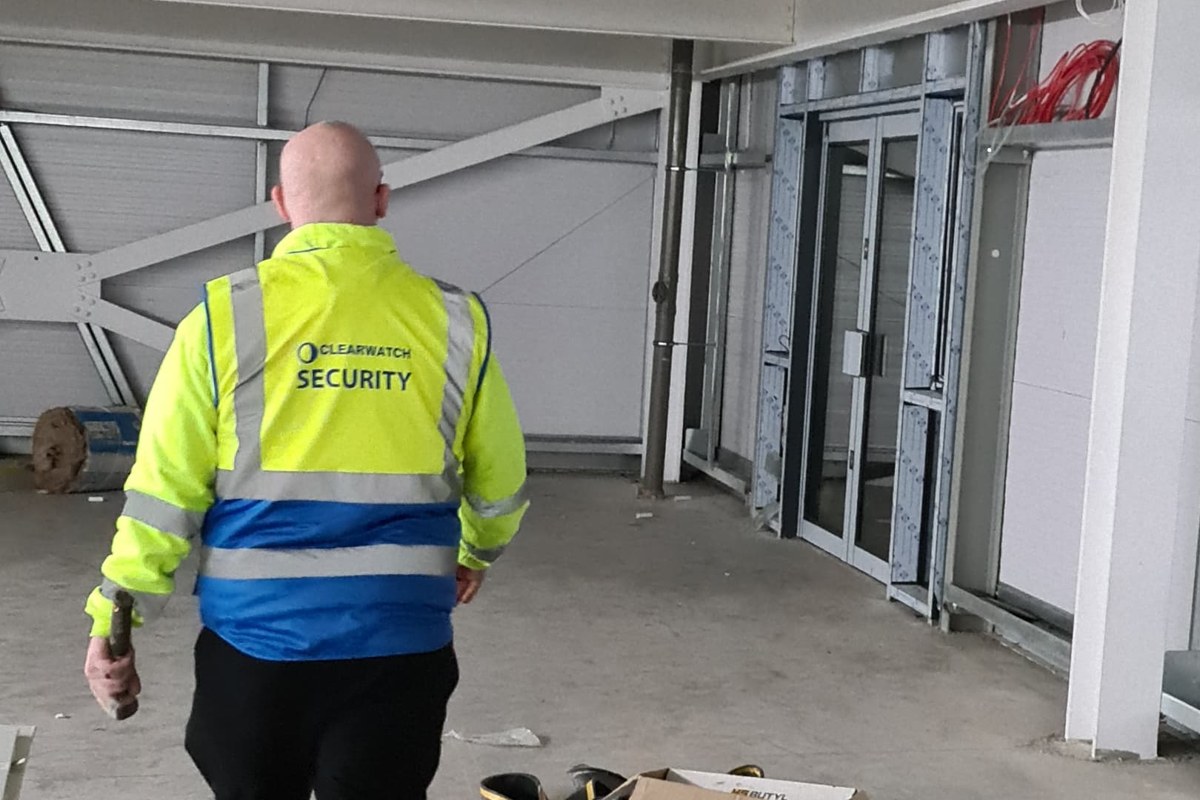
What our patrol found at 11pm
Most conversations about construction site security start after something has gone wrong. This one starts with something that didn’t.
Last Thursday at 11pm, one of our mobile patrols pulled up at a storage site that is still under construction. It was a routine visit on a quiet night.
Someone had got there first. They had cut through the perimeter fencing and carried bolt cutters, screwdrivers and a hammer right up to the main doors. When they heard the patrol vehicle arrive, they ran, and the tools stayed where they fell. We called the police, who attended.
They took nothing. Nobody was hurt. The only evidence anyone had been there was a hole in the fence and a small pile of tools by the door.
It would be easy to file that under good luck. Instead, we think it’s more useful to ask what it shows about how thieves choose a site, and what stops them.
Why a site mid-build is a target
A building under construction has most of what a thief wants and little of what puts them off.
- There is plenty worth taking. New cable, copper pipe, power tools, plant and boxed materials are easy to carry and easy to sell.
- The protection isn’t finished. Alarms and CCTV are often among the last things to go live. Doors may go in before locks, and fencing is temporary.
- Nobody is there at night. Trades leave in the late afternoon and the site sits empty until morning.
- Unfamiliar faces are normal. With different contractors on site each week, someone looking around in daylight doesn’t stand out.
What a break-in really costs
The stolen items are usually the smallest part of the bill. Picture the same Thursday night without a patrol visit.
Nobody would have known until the first worker arrived in the morning. The day would then go on police statements, an insurance claim and emergency repairs to doors and fencing. Stolen cable needs re-ordering and re-running, and trades booked for that week have to wait. As a result, a programme that slips by a few days can push back a handover or an opening date.
That knock-on delay is why construction site security is worth thinking about before the first delivery arrives, not after the first loss.
What good construction site security looks like
No single measure protects a site on its own. Rather, what works is a few layers, each making the next one harder to get past.
The basics every site should have. Solid, well-fixed fencing with no gaps. Lighting on gates, doors and storage areas. Tools and high-value materials locked in a secure store or taken off site each night. These cost little and remove the easy opportunities.
Temporary alarms and CCTV. Battery or solar-powered systems can protect a site long before the permanent ones go in. They are only as good as the response behind them, so be clear on who gets the alert and who actually attends.
Mobile patrols. A patrol visits at varied times through the night, checks the perimeter, doors and storage, and reports what it finds. The value is in the unpredictability, because people planning a break-in tend to watch a site first, and a visit they can’t time is hard to plan around. Patrols suit sites that are empty overnight but don’t justify someone on site full time.
A security officer on site. For larger or higher-risk projects, or at the stage when the most valuable kit goes in, an officer on site overnight may be the right call.
For a fuller checklist, Secured by Design, the official police security initiative, publishes a free Construction Site Security guide covering perimeters, lighting, CCTV and the protection of plant and tools. If your project is an interior refit, our guide to office fit-outs covers access control during the works.
Does every site need a patrol?
No, and it’s worth being honest about that. A small refurb in a busy, overlooked street with nothing valuable left overnight may be fine with good locks, lighting and a tidy site. However, the risk rises with the value of what’s on site, how isolated it is, how long it stands empty, and whether thieves have targeted it before.
A sensible approach is to match the cover to the stage of the build. For example, many projects need very little at the start and more once cable, plant and fittings arrive.
Five checks to do this week
Whether you run a building site, a yard or a finished premises, these take less than an hour.
- Look at your site from the road after dark. Note what you can see from outside and where someone could get in unseen.
- Walk the fence line. Look for cut, lifted or loose panels. They are easy to miss and easy to use.
- Lock tools and materials away every night. Not just at the weekend. Bolt cutters are only useful if there is something worth cutting through to.
- Light the doors, not just the car park. Entrances and fire exits are where break-ins start.
- Ask whether the alarm and CCTV are live yet. If they aren’t, ask who is watching the site at night and who gets the call if something happens.
Construction site security: common questions
Who is responsible for security on a construction site?
Under the Construction (Design and Management) Regulations 2015, the principal contractor must take reasonable steps to prevent unauthorised people getting onto the site. In practice the client, contractor and any security provider should agree who covers what before work starts.
Do small building sites need security?
Not always. A small, overlooked site with nothing valuable left overnight may only need good fencing, lighting and locked storage. The need grows with the value of materials on site, how isolated it is and how long it stands empty.
How do mobile security patrols protect a building site?
A patrol visits at varied times through the night, checks fencing, doors and storage areas, and reports anything out of place. Because nobody can predict the visits, they are hard to plan a break-in around.
When is a construction site most at risk?
Overnight and at weekends, and especially once cable, copper, plant and fittings have arrived but before permanent alarms and CCTV are working.
What should I do if I find signs of an attempted break-in?
Don’t move anything. Report it to the police, photograph the damage and anything left behind, repair the fence the same day, and review what was visible or accessible from outside.
The patrol nobody could time
The people at that storage site had planned their night. They brought the tools, cut the fence and reached the doors. What they hadn’t planned for was a patrol turning up when it did.
That is the whole point of a mobile patrol. It doesn’t need to be there all night. It needs to arrive when nobody expects it.
If you have a project underway or a site that sits empty overnight in Greater Manchester, we’re happy to talk through what it needs, including when the honest answer is “not much”.